
25 Most Beautiful Places in Italy: Cities, Villages & Lakes
Italy has a way of pulling you back again and again. I’ve been four times now, and every visit feels like peeling back another delicious layer — one trip it was all about wandering Rome’s piazzas and savouring cacio e pepe, another it was sipping an Aperol on Lake Como with the mountains as a backdrop. On my most recent adventure, I headed to Modena to taste balsamic vinegar straight from the barrel and tour the Ferrari factory before spending three food-filled days in Bologna.
It’s no surprise that Italy tops so many travel wish lists. Where else can you wake up to Renaissance art in Florence, drift down Venice’s canals, then be tucking into silky ribbons of tagliatelle al ragù by dinner? From the drama of the Amalfi Coast to hilltop towns like Siena, and the glitz of Milan to the rustic charm of Emilia-Romagna’s countryside, the country is a patchwork of culture, history, and jaw-dropping scenery.
I’ve been lucky enough to visit more than half the destinations in this guide, and every trip has shown me something new. This guide brings together the most beautiful places in Italy — not just the obvious landmarks, but also charming villages, shimmering lakes, and foodie havens I’ve explored myself. Some spots you’ll know well (yes, Rome and Venice live up to the hype), while others are underrated gems where you can eat, drink, and travel like a local.
So, if you’re wondering where to go in Italy, looking for the best places to visit in Italy, or simply daydreaming about your next escape, this list will give you plenty of inspiration. From cities and towns to landscapes and hidden corners, here are 25 places that prove why Italy will always be one of the world’s most beautiful countries.
This guide is part of my Italy Travel Guides, which brings together what to see, where to go, and how to plan your time.
This article may contain affiliate links. If you book through them, I may earn a small commission at no extra cost to you.
Most Beautiful Cities in Italy
Rome
Rome is a city that doesn’t just show you history — it throws you right into it. One minute you’re walking past the Colosseum, the next you’re sipping coffee in a square that’s been buzzing since the Renaissance. The Pantheon is still jaw-dropping even after multiple visits, with its perfect dome and a shaft of light that moves across the marble floor like a sundial.
Piazza Navona and Campo de’ Fiori are great for people-watching, while Trastevere offers a more bohemian vibe with ivy-covered trattorias and cobbled alleys. Food is part of the experience here: try a plate of cacio e pepe, crisp Roman-style pizza, or a scoop of gelato as you wander between fountains. Rome is chaotic, beautiful, and unforgettable — exactly what you want from a capital city that’s been reinventing itself for 2,000 years.

Florence
Florence is one of those places that manages to feel both overwhelming and intimate at the same time. The Duomo dominates the skyline, a masterpiece you can spot from almost any street. Inside the Uffizi, Botticelli’s Venus still steals the show, while Michelangelo’s David looks impossibly alive in the Accademia. But it’s not all art galleries — Florence is just as much about its street life.
The Mercato Centrale is heaven for food lovers, with stalls selling everything from fresh pasta to truffle oil, and evenings are best spent with a glass of Chianti in hand. Cross the Ponte Vecchio and explore the Oltrarno, where artisan workshops keep centuries-old crafts alive. Florence is a city that wears its history proudly, but it’s also a place where every meal, every piazza, and every sunset over the Arno feels like part of the story.

Venice
There’s nowhere else quite like Venice. A maze of canals and bridges, it’s a city that reveals itself slowly as you wander. St Mark’s Basilica glitters with mosaics, while the Doge’s Palace tells the story of a powerful maritime empire. But the real magic happens when you step away from the crowds. A vaporetto ride along the Grand Canal is a must, but so is getting lost in quieter districts like Cannaregio or Dorsoduro, where washing lines criss-cross above narrow alleys and locals sip spritz in tiny bars.
Venice is full of contrasts: dazzling palaces next to crumbling facades, gondolas gliding past busy vaporetto stops, silence broken only by church bells. Add in cicchetti (Venetian tapas) and glasses of prosecco, and you’ve got a city that’s as much about living well as it is about looking beautiful.

Milan
Often overlooked, Milan blends history and modern style better than any other Italian city. The Duomo is jaw-dropping, especially if you climb to the rooftop, while the Galleria Vittorio Emanuele II makes shopping feel like an art form. After a day exploring, join the locals for aperitivo — Milan practically invented it. For me, it’s one of the best cities in Italy if you like a mix of culture, fashion, and food.

Bologna
I spent three days in Bologna, and it instantly became one of my favourite Italian cities. The endless porticoes give the city a unique rhythm, while Piazza Maggiore feels like a stage set for people-watching. And then there’s the food — tagliatelle al ragù, mortadella, and tortellini in brodo. Bologna is the food capital of Italy, and I loved exploring its buzzing markets and trattorias. If you’re wondering where to go in Italy for food, Bologna is the answer.

Most Beautiful Towns and Villages in Italy
Positano
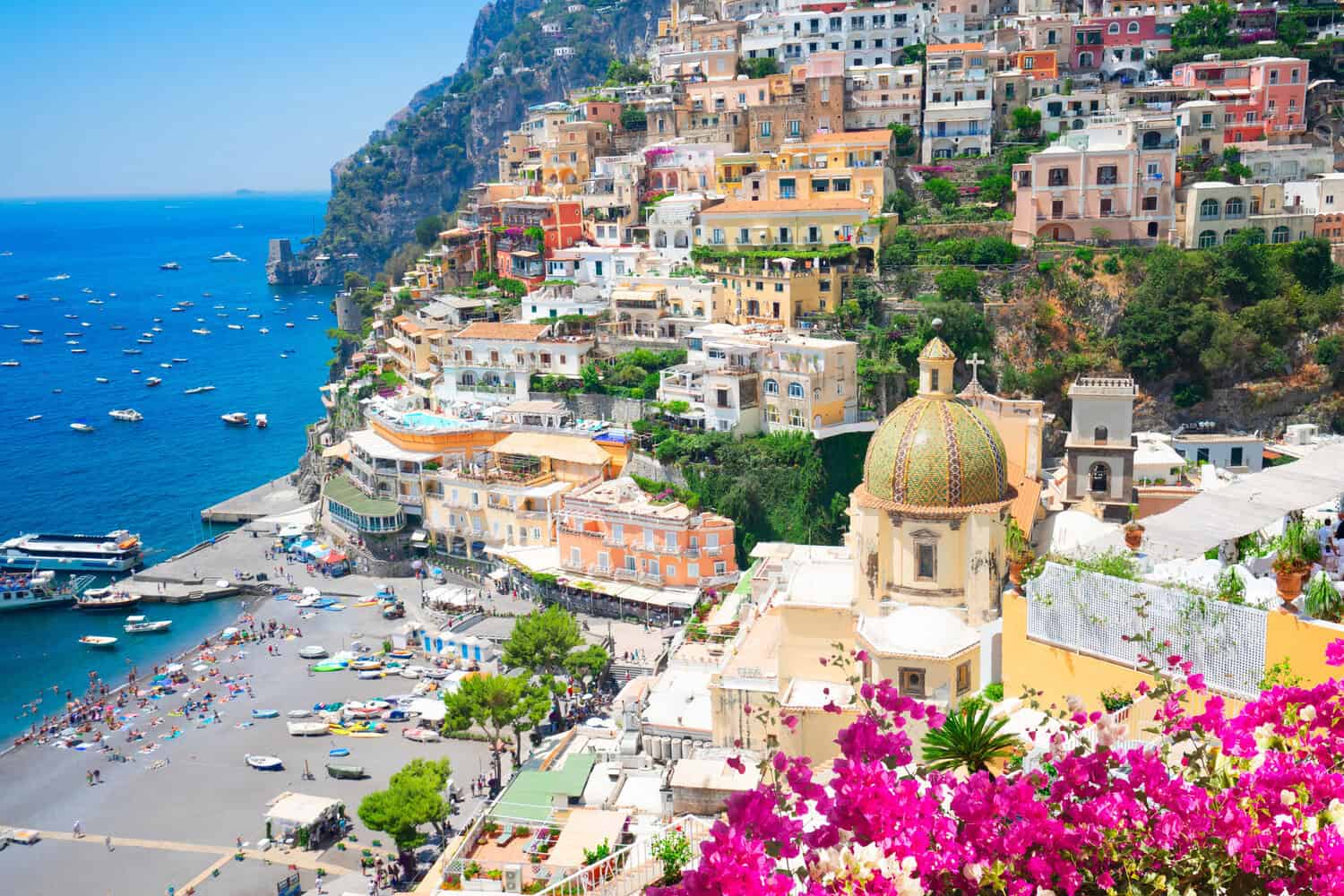
Stacked in pastel layers down the cliffs, Positano is one of those places that feels almost unreal. Everywhere you look, there’s another postcard view — balconies dripping with bougainvillaea, steep staircases that tumble to the beach, boats bobbing on the turquoise water. It’s a place that’s as much about atmosphere as it is about sightseeing. Days here drift by in slow motion: a coffee on a terrace with sea views, a wander through boutiques selling linen and handmade sandals, a lazy afternoon on the pebbled beach.
When the sun starts to set, the whole town glows golden and the restaurants along the waterfront come alive with chatter and the smell of grilled seafood. Positano might be photographed a million times, but standing there with the cliffs behind you and the sea ahead, it feels like you’ve stepped right into a dream.
Ravello
High above the Amalfi Coast, Ravello has a way of making you forget time altogether. From the Terrace of Infinity at Villa Cimbrone, the view seems to roll on forever, while Villa Rufolo’s gardens explode with colour in summer. But what gives the town its character isn’t just the famous views — it’s the calm rhythm of daily life.
The market is piled with wheels of cheese and sun-drenched fruit, narrow lanes twist past stone houses, and small churches hide frescos inside. As evening falls, locals and visitors spill into the main square, wine glasses in hand, while musicians play against a backdrop of glowing lanterns. Ravello doesn’t shout for attention, and that’s exactly its charm.

Siena
With its medieval brick buildings and fan-shaped piazza, Siena feels like a city perfectly preserved. Piazza del Campo is the centrepiece, where crowds gather for the famous Palio horse race, but it’s just as captivating on an ordinary day when cafés spill out onto the cobbles. The Duomo, striped in black and white marble, is a masterpiece inside and out, and climbing the Torre del Mangia rewards you with sweeping views over terracotta rooftops. The beauty of Siena is in its details — a hidden alley lined with shops, a slice of panforte from a bakery, the echo of bells across the hills. Compared to Florence, just an hour away, Siena feels more intimate, more medieval, and somehow more atmospheric.

Bellagio (Lake Como)
Nicknamed the “Pearl of Lake Como,” Bellagio is all elegance with just enough rustic charm to keep it grounded. Cobbled stairways climb past colourful houses, boutiques brim with silk scarves, and waterfront cafés line the promenade. The lake is the star — ferries glide across the water, framed by mountains that change colour with the light.
It’s easy to spend a whole afternoon doing very little here: sipping a spritz, watching the boats, and deciding whether to go for another gelato (the answer is always yes). Bellagio may be polished, but it hasn’t lost its soul, and that mix of beauty and ease is what keeps people coming back.

Matera
Few places in Italy surprise travellers quite like Matera. The Sassi, a maze of cave dwellings carved into cliffs, make the town look more like a film set than a real place. Walking through its stone alleys, you catch glimpses of tiny churches and homes carved straight from rock, reminders of life here that stretches back thousands of years.
By day, the honey-coloured stone glows in the sun; by night, the whole town lights up like a nativity scene. Matera isn’t fancy — that’s part of its appeal. It feels raw, historic, and unlike anywhere else in Italy. Standing on a viewpoint as the bells ring out over the canyon is one of those goosebump travel moments you don’t forget.

Alberobello
In the heart of Puglia, Alberobello looks like it belongs in a fairytale. Its trulli houses — whitewashed stone huts topped with conical roofs — are scattered across the town in clusters, creating a skyline unlike any other. Wandering through the narrow lanes feels whimsical, but it’s also very much a lived-in place.
You’ll find locals chatting outside their doorways, shopkeepers selling olive oil and wine, and bakers sliding focaccia from wood-fired ovens. While it can get busy in peak season, there’s still plenty of charm if you explore beyond the main streets. Alberobello might be small, but its unique architecture and warm southern welcome make it a standout stop in Italy.

Civita di Bagnoregio
Located on a crumbling hilltop and reached only by a footbridge, Civita di Bagnoregio is often called “the dying town.” But step inside its medieval gates and you’ll find cobbled streets, flower-filled balconies, and a quiet that feels almost otherworldly. The views over the surrounding valley are breathtaking, especially in late afternoon when the light turns golden.
There isn’t a long list of sights here — the town itself is the attraction. You wander, you pause in a café, you take in the silence. It’s tiny, fragile, and yet unforgettable. For many travellers, Civita is less about what you do and more about how it makes you feel: like you’ve stumbled into a piece of history hanging on by a thread.

Most Beautiful Landscapes & Natural Spots
Lake Garda
Lake Garda is Italy at its most dramatic — cliffs plunging into glittering water, castles perched on rocky outcrops, and lemon groves tumbling down the hillsides. The north has an adventurous feel, with windsurfers and paragliders making the most of the mountains, while the south is all about lazy days by the shore, vineyards, and thermal baths. Towns like Sirmione and Malcesine bring history into the mix, with Roman ruins and fairytale fortresses right on the water’s edge. It’s a lake that manages to be lively and relaxing all at once. Order a spritz in a piazza, watch the ferries criss-cross the water, and you’ll understand why Garda is one of the good places to visit in Italy for both culture and downtime.

Lake Orta
Small, serene, and often overlooked, Lake Orta is a gem among Italy’s lakes. The medieval village of Orta San Giulio sits on a peninsula reaching into the water, its cobbled lanes lined with trattorias and tiny shops. Just offshore, Isola San Giulio rises like a vision, crowned by a monastery and ringed with pastel houses.
The lake has a quieter, more intimate feel than Como or Garda, making it a favourite for travellers who prefer quiet. Sit by the shore with a glass of local wine and you’ll soon see why Orta is often called one of the prettiest places in Italy — it has all the beauty without the bustle.

Dolomites
The Dolomites look like something out of a fantasy novel — jagged limestone peaks that catch the light in shades of pink and gold. This UNESCO-listed region in northern Italy is a paradise for hikers and skiers, but you don’t have to be outdoorsy to fall for it. Scenic drives wind through mountain passes, villages with wooden chalets serve apple strudel, and cable cars whisk you up to viewpoints that make your jaw drop.
In summer, alpine meadows explode with wildflowers; in winter, the snow turns everything into a postcard. Few places show off the most beautiful parts of Italy quite like the Dolomites, where nature takes centre stage.

Amalfi Coast
The Amalfi Coast is the stuff of legend: pastel towns clinging to cliffs, lemon groves perfuming the air, and the sea shimmering below. It’s as dramatic as it is beautiful, whether you’re winding along the coastal road or gliding between villages by ferry. Amalfi has grand cathedrals and bustling piazzas, while Positano and Ravello add glamour and tranquillity. Even a simple lunch of seafood and pasta feels special when the view stretches for miles. This is one of the ultimate must see Italy experiences — a stretch of coast that’s inspired writers, painters, and travellers for centuries.

Sardinia
When it comes to beaches, Sardinia is in a league of its own. The Costa Smeralda has white sand and turquoise water, with a touch of glitz thrown in, while the island’s west coast is wilder, with rugged cliffs and hidden coves. Away from the shore, you’ll find ancient nuraghe stone towers, colourful markets, and some of the best seafood in the country. There’s a sense of space here that feels different from mainland Italy — wide horizons, endless coastline, and villages where life moves at its own pace. For many, Sardinia is one of those Italy vacation spots that delivers the perfect mix of relaxation and adventure.

Sicily
Sicily feels like a world within a world. Its history is layered into every corner — Greek temples at Agrigento, Baroque piazzas in Noto, and Norman mosaics in Palermo. Add in Mount Etna, Europe’s most active volcano, and you’ve got a landscape that’s as dramatic as its past. Food is central here: arancini stuffed with ragù, granita with brioche for breakfast, cannoli filled with sweet ricotta.
The markets are a riot of noise and colour, with vendors calling out over piles of citrus and seafood. Then there are the beaches, from sandy stretches to rocky coves with crystal-clear water. Sicily doesn’t hold back — it’s bold, energetic, and captivating. For many travellers, it’s one of the Italy major tourist attractions that ends up stealing the whole show.

Lake Maggiore
Stretching into Switzerland, Lake Maggiore has a gentler, more elegant vibe than its flashier neighbours. The highlight is the Borromean Islands, a cluster of tiny isles topped with palaces and gardens straight out of a Baroque fantasy. Isola Bella in particular is unforgettable, with terraces spilling over with flowers and even peacocks strutting across the lawns. Towns like Stresa and Verbania add charm with their lakeside promenades, making Maggiore an easy place to slow down. For anyone looking for popular sites in Italy that aren’t overrun, Lake Maggiore offers beauty with breathing space.

Hidden Gems in Italy
Modena & Parma (Emilia-Romagna)
If food is your thing, Modena and Parma are the jackpot. Modena is home to balsamic vinegar that’s been aged for decades in tiny barrels — the real stuff is syrupy, sweet, and nothing like what you find in the supermarket. Parma is all about silky prosciutto and Parmesan wheels the size of small boulders.
Both towns are small enough to explore in a day, but packed with character: cobbled piazzas, Romanesque cathedrals, and trattorias where nonna is still in the kitchen. Modena also has a flashier side — the Ferrari Museum revs things up for car fans. This part of Emilia-Romagna proves Italy isn’t only about the big cities; it’s about flavour, tradition, and a slower pace that leaves a lasting impression.

Puglia
Tucked away in the heel of Italy’s boot, Puglia feels like another world. The coastline is dotted with limestone cliffs, secret coves, and whitewashed towns that glow in the sun. Polignano a Mare sits dramatically on the edge of a cliff, its houses clinging to the rock above turquoise water, while Lecce’s golden Baroque architecture gives it the nickname “the Florence of the South.”
Food here is rustic and hearty — think orecchiette pasta with turnip tops, drizzled with peppery olive oil. Puglia still feels unspoilt, and that’s part of its charm. It’s a region that rewards slow travel, relaxing in cafés, and evenings where the only decision is which beach to explore the next day.

Ischia
Everyone knows Capri, but Ischia is where Italians escape to. This volcanic island in the Bay of Naples is lush and green, with thermal springs bubbling up into natural spas. Beaches curve around the coast, some sandy, others rocky, all with that dramatic Campanian backdrop. Castello Aragonese, perched on its own islet, looks like something straight out of a medieval painting.
The island’s food is a mix of hearty rabbit stews and fresh seafood, best enjoyed at a beachside trattoria with a carafe of local white wine. Ischia has glamour if you want it, but it also feels more lived-in than Capri — less about posing, more about unwinding. It’s the sort of place where a long lunch turns into an entire afternoon, and nobody’s in a rush.

South Tyrol
Italy isn’t all sun and sea — head north to South Tyrol and it feels like a different country. Here, the Dolomites rise above vineyards, and villages look more Austrian than Italian. Wooden chalets serve apple strudel alongside espresso, menus are in both German and Italian, and the mix of cultures gives the whole region a unique flavour.
Hiking trails wind through alpine meadows in summer, while winter is ski season in resorts like Val Gardena. But it’s not just for outdoor lovers — the wine here is excellent, especially crisp whites like Gewürztraminer. South Tyrol is a reminder that Italy’s beauty isn’t just about coastal towns or Renaissance cities; it’s about contrasts, and this region has them in spades.

Practical Tips for Visiting Italy
Best Time to Visit Italy
Italy changes with the seasons, and the best time to go really depends on what you want out of your trip. Spring (April–June) and autumn (September–October) are hard to beat — warm days, cooler evenings, and fewer crowds than peak summer. I love Florence in May, when the city is buzzing but not yet packed, and the wisteria is in bloom. July and August mean soaring temperatures and higher prices, but they also bring festivals, long beach days, and lively evenings. Winter can be atmospheric too, especially in cities like Rome and Venice, where the crowds thin and Christmas markets add a festive sparkle.
Getting Around Italy
The train system in Italy is fast, affordable, and one of the easiest ways to see the country. High-speed trains link major cities like Rome, Florence, Venice, andMilan in just a couple of hours, while regional trains connect smaller towns. If you’re heading to the countryside or the Amalfi Coast, hiring a car gives you more freedom (and a few hair-raising driving stories). Ferries are a fun option for coastal areas and islands — hopping between Amalfi towns or heading out to Sicily or Sardinia.
Food & Drink
Eating in Italy is half the experience, so plan to linger over meals rather than rushing from sight to sight. Each region has its own specialities: pasta in Bologna, pizza in Naples, seafood on the Amalfi Coast, and cannoli in Sicily. Markets are a great way to sample local flavours — even small towns often have weekly stalls groaning with cheeses, cured meats, and seasonal fruit. Don’t forget aperitivo: early evening drinks paired with snacks, which are practically a tradition everywhere from Milan to Palermo.
Money & Practicalities
Italy is generally affordable once you’re on the ground, especially if you eat in local trattorias rather than touristy spots. Cash is still useful, particularly in small villages or markets, though cards are widely accepted in cities. Book popular attractions in advance — skip-the-line tickets save hours in places like the Vatican or the Uffizi. And don’t underestimate the power of a good pair of shoes: with cobbled streets and lots of walking, comfort is key.
Map of the Most Beautiful Places in Italy
Here’s how all the cities, villages, landscapes, and hidden gems from this guide fit together — a handy map to help you plan your own Italian adventure.
How to use this map: Zoom in, click the pins, and use this map to plan which of Italy’s most beautiful places to add to your trip. Red marks the cities, blue highlights the towns and villages, green shows the landscapes, and purple points out the hidden gems.
FAQs About Visiting Italy
What are the most beautiful cities in Italy?
Italy is full of contenders, but the cities most often called beautiful are Rome, Florence, Venice, Milan, and Bologna. Rome dazzles with ancient landmarks, Florence with Renaissance art, and Venice with its canals and palaces. Milan mixes history with high fashion, while Bologna has food and medieval character. Each has its own vibe, so the “most beautiful” really depends on your taste — grandeur, romance, or food culture.
Which towns and villages should I not miss?
Italy’s small towns are some of its biggest treasures. On the Amalfi Coast, Positano and Ravello are classics, while Siena in Tuscany delivers medieval charm in spades. Bellagio on Lake Como is elegant and relaxed, Matera amazes with its cave dwellings, and Alberobello is pure storybook magic with its trulli houses. For something truly unique, Civita di Bagnoregio — reached by a footbridge — is unforgettable.
What is the best time to visit Italy?
The best time to visit Italy is usually spring (April–June) and autumn (September–October). These months bring warm weather, fewer crowds, and plenty of festivals. Summer is lively and great for the coast, but expect higher prices and hotter days, especially inland. Winter has its own charm, with Christmas markets, fewer tourists in big cities, and ski season in the Dolomites.
What are Italy’s must see places for first-time visitors?
If it’s your first trip, the must see places in Italy are Rome, Florence, and Venice — they’re classics for a reason. Add the Amalfi Coast for drama and Sicily for a dose of culture and coastline. With more time, places like Bologna, Siena, or the Italian Lakes give you a sense of the country’s variety beyond the famous trio.
Where can I find the best food in Italy?
For food, Bologna is often called the culinary capital, with dishes like tagliatelle al ragù and tortellini in brodo .Naples is the birthplace of pizza, Parma gives you silky prosciutto and Parmesan cheese, and the Amalfi Coast shines with seafood and limoncello. Sicily is unmissable for street food and sweets — think arancini, cannoli, and granita. Wherever you go, local specialities are the highlight.
What are the best beaches in Italy?
Italy has beaches to suit every taste. Sardinia is famous for white sands and turquoise water, while Sicily mixes rugged coves with long sandy stretches. The Amalfi Coast has dramatic beaches framed by cliffs, though they can be pebbly and busy. For something quieter, Puglia’s coastline delivers crystal-clear water and hidden coves.
How many days should I spend in Italy?
It depends on what you want to see. A week gives you a taste of two cities, maybe three. Ten days to two weeks lets you cover Rome, Florence, Venice, and the Amalfi Coast without rushing. If you’ve got longer, you can add regions like Emilia-Romagna, Sicily, or the Lakes. Italy isn’t a place to rush — the longer you stay, the more rewarding it becomes.
Italy has a way of getting under your skin. One day you’re eating pasta in Bologna, the next you’re watching the sunset on the Amalfi Coast, and suddenly you’re already planning your next trip back. Big cities, tiny villages, lakes, mountains, islands — it all feels endlessly varied, yet unmistakably Italian.
🌿Explore Italy
Fallen for Italy? Places worth the flight — and every plate of pasta.— from art-filled cities to sun-soaked coastlines.
- Venice – Canals, historic neighbourhoods, and a city best explored on foot.
- Amalfi Coast – Colourful villages, cliffside views, and limoncello sunsets.
- Rome – Ancient ruins, hidden trattorias, and unforgettable gelato.
- Tuscany – Vineyards, hill towns, and golden countryside drives.
- Florence – Renaissance art, rooftop views, and perfect pasta.
- Naples – Ancient streets, world-famous pizza, and vibrant local life.
- Bologna – Italy’s food capital — mortadella, tagliatelle, and endless flavour.
🌿 Travelling beyond Italy
Looking for inspiration beyond Italy? Browse more destinations and food-focused guides from across the blog.
- Destination Guides – Cities, regions, and trip ideas across Europe and beyond.
- Food & Drink – What to eat, local specialities, and market-led guides.


